Ice in a planetary cauldron

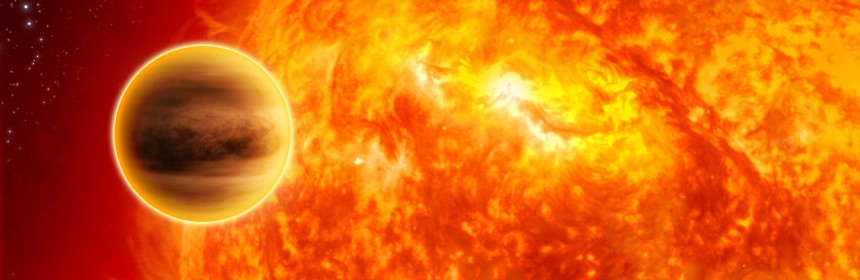
With temperatures in excess of 800 F, Mercury is one of the last places in the solar system you’d expect to find ice. But when NASA’s Messenger spacecraft transmitted its first optical images of the closest planets to the sun, that’s exactly what scientists discovered. Mercury sits about 36 million miles from the sun, which is roughly 57 million miles […]

Read more

Starburst galaxy sheds light on longstanding cosmic mystery

Scientists from the University of Delaware’s Bartol Research Institute in the Department of Physics and Astronomy have discovered very-high-energy gamma rays in the Cigar Galaxy (M82), a bright galaxy filled with exploding stars 12 million light years from Earth. The gamma rays observed by the team have energies more than a trillion times higher than the energy of visible light […]

Read more

Gold’s cosmic origins

gold meteor

All the gold on Earth was forged in the collisions of massively dense stars billions of years ago. Astronomers have come to this conclusion after observing and analyzing the afterglow of a crash between two neutron stars in a galaxy 3.9 billion light-years away that yielded a hoard of gold likely equal to the mass of 20 Earths. “At today’s […]

Read more

Voyager 1 Escaping Our Solar System

On the 35th anniversary of its launch, the Voyager 1 spacecraft is close to becoming the first man-made object to escape our solar system. The spacecraft—run by a 1977 computer 100,000 times less powerful than an iPod Nano—is currently 11.3 billion miles away. In 2004, Voyager 1 entered the turbulent boundary zone beyond Pluto, where solar winds encounter plasma pushing […]

Read more

A monster black hole

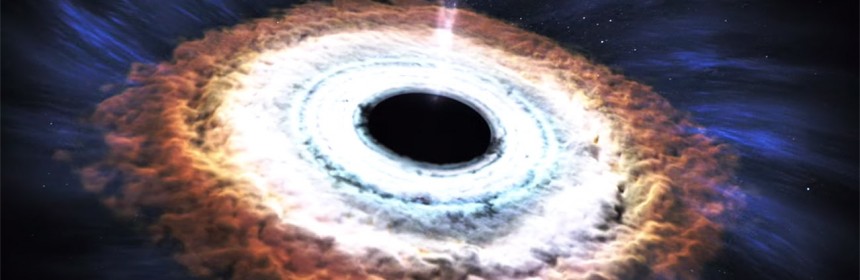
An international team of astronomers has detected a colossal black hole that is 12 billion times more massive than the sun—so big that it is challenging accepted cosmological thinking. Scientists discovered the enormous celestial body, which is 12.8 billion light-years from Earth, at the center of a brilliantly glowing quasar, a cloud of gas that gets superheated and gives off […]

Read more

Dark matter is (probably) more complex than you think

Scientists typically believe that dark matter behaves in a simple way: if one clump encounters another, the two interact solely through gravity. However, researchers have published findings which suggest that there’s more involved. They’ve noticed dark matter (the blue lines in the photo above) lagging behind a galaxy due to friction, hinting that there are factors beyond gravity at work. […]

Read more
1 2 3 4 5 6